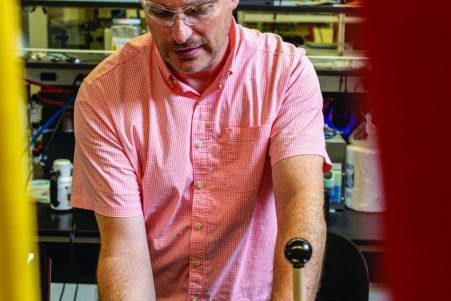
Haochen Li is developing a deep learning empowered flood hazard forecasting system for the East TN area that is more accurate than current flood risk models.
EECS Assistant Professor Doowon Kim received a National Science Foundation CAREER Award for his work on anti-phishing detection models.
UT researchers in collaboration with Mississippi State University are using a $5 million award to apply their expertise in advanced manufacturing, metallurgy, and welding to create new steels for the United States Navy.
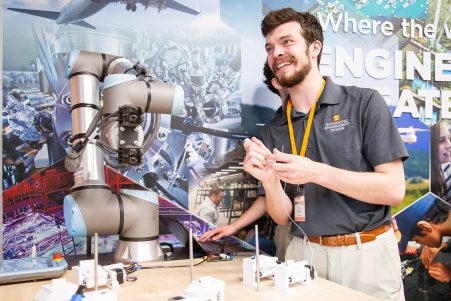
With two massive robot arms and a concrete 3D-printing nozzle, the Concrete Hybrid Autonomous Manufacturing Platform offers unique capabilities.
Researchers from across the Tickle College of Engineering received national awards, advanced research in machine learning, and reached out to the next generation of engineers.
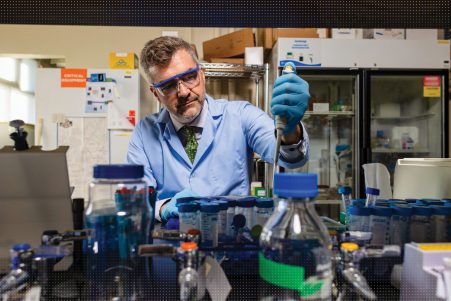
When a widely accepted theory couldn’t explain the data, Dalhaimer’s lab looked deeper—and revealed new possibilities for nanoparticle medicine.
BME Professor Jindong Tan is using a $1 million NSF grant to develop a fully insertable robotic imaging device for laparoscopic surgeries.
UT researchers are using AI and machine learning to speed up breast cancer treatment planning by analyzing pathology reports.
Taufer and Swaminathan lend their AI expertise to a $5M project to overhaul Pegasus, the NSF’s nationwide workflow management system.
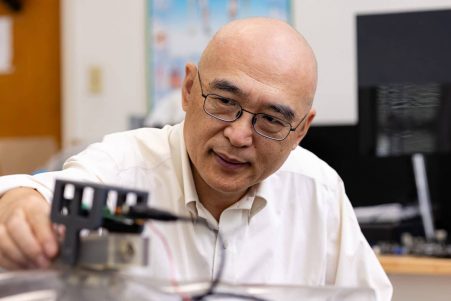
By incorporating Jayne Wu and Shigetoshi Eda’s AiCAP sensor, a new device from CFD Research can reliably diagnose complex diseases like PTSD with a single test.
After nearly a decade as a stormwater engineer, Ceara Parks Oliver is developing a restoration framework to aid engineers and scientists to improve watershed health.

Wiring harnesses are essential for controlling the electrical components of an automobile and transmitting power to every part of the...