
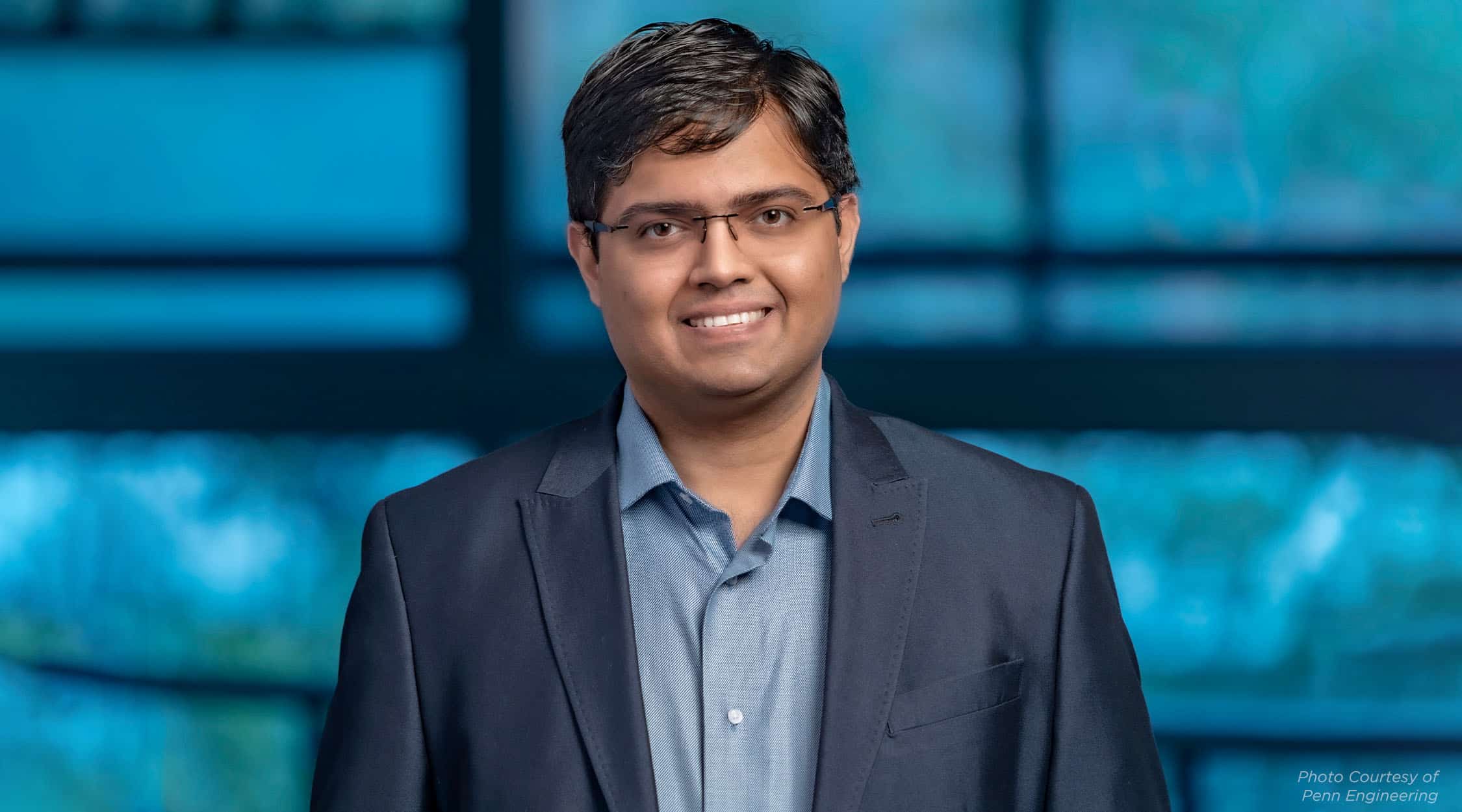
Jariwala Named UT-ORNL Governor’s Chair
Deep Jariwala, a nationally recognized leader in quantum materials and next-generation electronic devices, is joining the college as a UT-ORNL Governor’s Chair for Quantum Devices. Upon his arrival in January 2027, Jariwala will hold a joint appointment between UT and Oak Ridge National Laboratory, with his academic home in TCE’s Department of Materials Science and Engineering. Jariwala joins UT after nine years at the University of Pennsylvania, where he was most recently an associate professor and the Peter and Susanne Armstrong Distinguished Scholar in electrical and systems engineering and materials science and engineering. Jariwala is widely recognized for his work at the intersection of novel materials, microelectronics, and computing systems. His research focuses on developing novel materials and “chips of the future” that enable next-generation computing, sensing, and optoelectronic systems that use artificial intelligence.
Read more about Jariwala becoming UT-ORNL Governor’s Chair.

UT Part of $25M DOE Grant Awarded to Consortium
UT is part of a University of California, Berkeley-led consortium that was awarded a $25 million grant by the U.S. Department of Energy’s National Nuclear Security Administration in December 2025 for research and development in nuclear science, engineering, and security. The grant, awarded for the fourth time to a UC Berkeley-led consortium, follows the announcement of a funding opportunity issued in 2024. UT is one of nine universities and six national laboratories involved in the consortium. The new award will focus on two objectives: (1) perform research in the basic science and engineering disciplines foundational to nuclear nonproliferation in collaboration with DOE national laboratories; and (2) develop world-class nuclear scientists and engineers with expertise in the critical disciplines required for careers in the national laboratories and other government agencies with nuclear missions. Faculty members from NE and MSE are involved in the project. The mission of the Nuclear Science and Security Consortium is to train the next generation of nuclear scientists and engineers, while carrying out research and development ranging from basic aspects of new technology and methods to programmatic work directly supporting the NNSA’s nuclear security and nonproliferation missions.
Read more about the $25M consortium grant.

UT Selected for EcoCAR Innovation Challenge
UT has been selected to participate in the EcoCAR Innovation Challenge, a four-year collegiate competition aimed at developing next-generation, energy-efficient and intelligent mobility solutions using emerging technologies. UT was one of 20 universities from across North America selected for the latest installment of the competition, which runs from the fall of 2026 through the spring of 2030. Since 1988, the college has taken part in 11 of the AVTC events. Over that span, more than 1,000 UT students have participated in the unique design experience. The college will field a collaborative team of students from MAE and EECS. Automakers General Motors and Stellantis are each sponsoring a separate competition track in the event to provide students with different engineering challenges and vehicle platforms that are designed to reflect real-world market choices. GM is supplying a 2026 Chevrolet Blazer EV and Stellantis is providing a 2026 Jeep Cherokee hybrid. UT was chosen for the Stellantis Track.
Read more about UT’s participation in the EcoCAR Innovation Challenge.

AI TechX Funds Taufer and Ng’s IBM Collaboration
In the spring of 2025, the University of Tennessee launched the AI TechX initiative to spur artificial intelligence research and innovation while increasing the AI preparedness of the state of Tennessee’s workforce. Over 30 teams led by UT faculty and their industry partners applied for the initial round of AI TechX seed grants—but selected just nine winning projects, each of which was awarded $60,000. One of the inaugural awards went to Mathworks Professor Michela Taufer and Research Assistant Professor Kin Ng for their proposed collaboration with International Business Machines Corporation (IBM). This collaboration addresses a gap in the current space of large language model (LLM) technology. There has recently been a great deal of investment and progress in training LLMs, but the output applications of such models—called prediction or inference—have lagged. IBM has a longstanding collaboration with Taufer, Ng, and other researchers in EECS and Computer Science working to integrate AI into cyberinfrastructure. When the AI TechX applications opened, Taufer and Ng’s collaborators at IBM suggested using the opportunity to apply the company’s AI models and inference tech to applications currently under study at UT.
Read more about Tafuer and Ng’s IBM Collaboration.

Kalinin Receives SEC Faculty Achievement Award
Sergei Kalinin, Weston Fulton Professor of Materials Science and Engineering at UT, has received a 2026 Southeastern Conference Faculty Achievement Award. One of the SEC’s highest honors, the award recognizes excellence in teaching, research and service. Kalinin is receiving the honor for driving innovation at the intersection of artificial intelligence and materials science, where his work is reshaping how new materials are designed, tested, and studied. At UT, Kalinin and his collaborators have built some of the nation’s first fully autonomous experimental platforms, including scanning probe microscopes and electron microscopes capable of operating with minimal human intervention and at an accelerated pace. For now, UT remains one of the only universities in the country with these capabilities fully built and operationalized. This highly collaborative approach has brought together researchers across disciplines to build capabilities that remain rare in the United States.
Read more about Kalinin’s SEC Faculty Achievement Award.

Meredith Named New CBE Department Head
Carson Meredith has been selected as the new head of the Department of Chemical and Biomolecular Engineering. Meredith joins UT after spending the last 26 years at Georgia Institute of Technology, where he served as professor in the School of Chemical and Biomolecular Engineering and the executive director of the Georgia Tech Renewable Bioproducts Institute. Meredith will take the reins of CBE from UT-ORNL Governor’s Chair for Biorefining Art Ragauskas, who served as the acting department head for nearly three years. Meredith researches the surfaces and interfaces of advanced materials. His work aims to apply fundamentals of polymer, surface, and colloid science to find new ways to engineer materials useful to society and industry. His projects emphasize the utilization of renewable components and sustainable processing to achieve circular manufacturing and in the use of plastics, composites, foams and coatings, among other things. Many of these materials are critical for food security, energy efficiency and are closely connected to greenhouse gas reduction. Meredith’s group at Georgia Tech pioneered in the area of using chitin and cellulose to derive alternative packaging materials as substitutes for plastic.
Read more about Meredith’s appointment to CBE department head.